Superior Water Treatment

Chemistry of Ozone

Explore the unique chemistry of ozone (O3) and its role in water treatment. Unlike other chemicals, ozone is oxygen-based and leaves no lasting residues, making it highly effective yet environmentally friendly. Its reactive yet short-lived nature ensures effectiveness without downstream concerns. 

Quick Answer: Ozone (O₃) is a triatomic oxygen molecule and one of the most powerful oxidants available, with an oxidation potential of 2.07 volts, stronger than chlorine (1.36 V) or hydrogen peroxide (1.78 V). Ozone destroys pathogens and pollutants by stripping electrons from their molecules, then decomposes back into oxygen (O₂), leaving no chemical residues. This makes ozone chemistry uniquely suited to water treatment where residual-free, high-potency oxidation is required.

An illustration of ozone molecules dispersing underwater, symbolizing its role in water purification and sanitation, ensuring a clean and healthy aquatic environment.

What is ozone (O₃)?

Ozone (O₃), or triatomic oxygen, is a colorless to pale blue gas and one of the most powerful commercially available oxidants, with an oxidation potential of 2.07 volts. Ozone is unstable in water, decomposing back to oxygen (O₂) within seconds to minutes depending on water quality conditions like pH, temperature, and organic load. Because its only byproduct is oxygen, ozone is safe for crops, livestock, and the environment, with no chemical residues accumulating in treated water. To understand what makes ozone so reactive, it helps to start with its precursor: oxygen.

How does oxygen relate to ozone chemistry?

Oxygen is the building block of ozone and the second most electronegative element on the periodic table, behind only fluorine. In the atmosphere, oxygen exists primarily as a diatomic molecule (O₂), while its reactive elemental form (O) is scarce in nature. Because of its high electronegativity, oxygen strongly attracts electrons from other atoms when it interacts with them, pulling or shifting electrons away to form compounds called oxides. This electron-stealing property is what makes oxygen, and its more reactive cousin ozone, so effective at breaking down contaminants in water treatment.

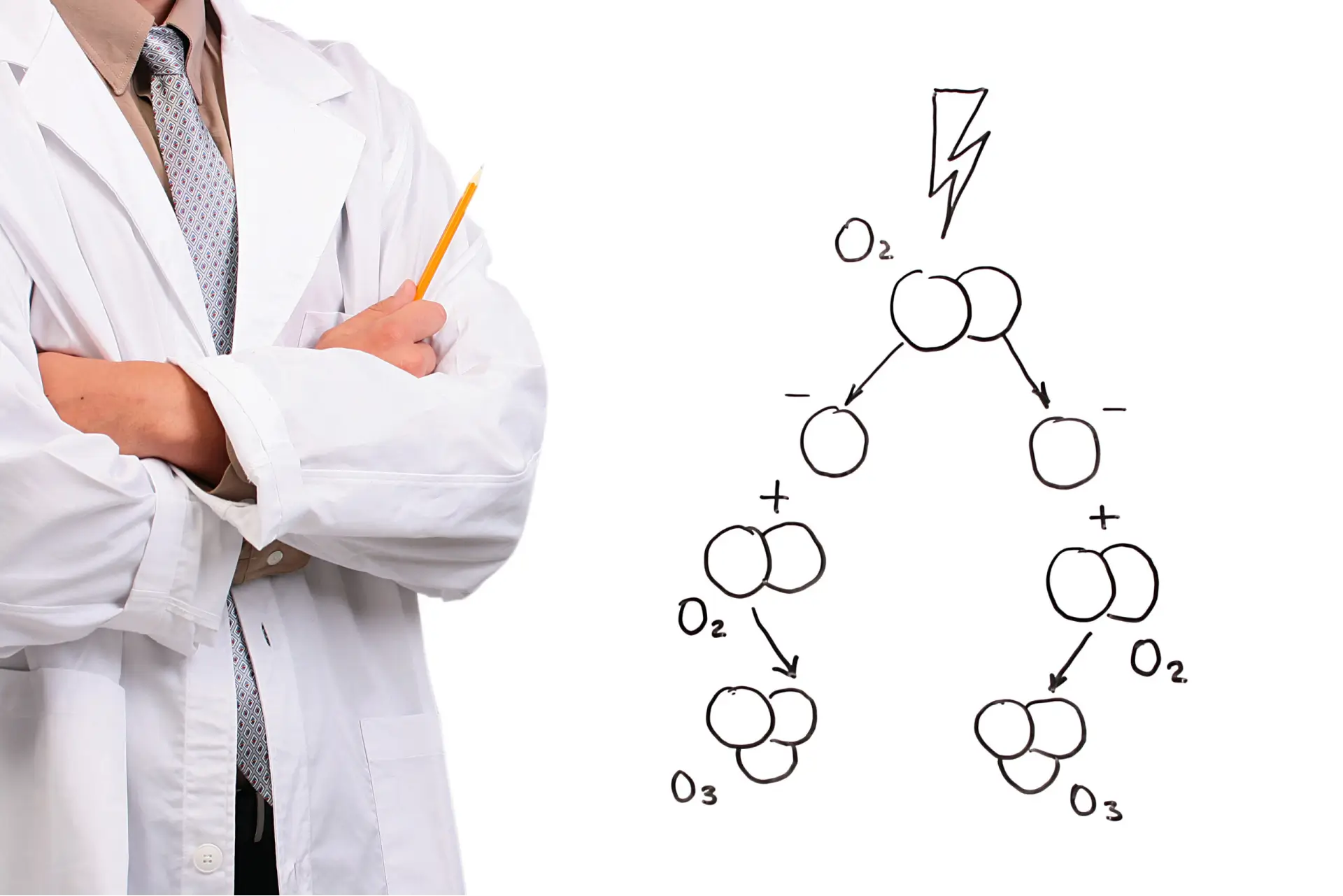
representation of the formation of oxygen
Oxidation potential of common disinfectants Higher voltage = stronger oxidizer Hydroxyl radical (OH) 2.86 V Oxygen atom (O) 2.42 V Ozone (O₃) 2.07 V Hydrogen peroxide (H₂O₂) 1.78 V Chlorine (Cl) 1.36 V Oxygen molecule (O₂) 1.23 V Chlorine dioxide (ClO₂) 0.95 V 0 V 1.5 V 3 V Ozone and related oxidants Traditional disinfectants Ozone is 52% stronger than chlorine, destroying pathogens and pollutants with no chemical residues

What is oxidation in water treatment chemistry?

In some of the examples below, addition of oxygen to molecules is defined as oxidation. Over time, the definition of oxidation was broadened to include any reaction where a chemical loses an electron in a reaction (whether or not oxygen is involved). Every atom has a nucleus, and electrons that circle around it in ‘orbitals’, similar to how the planets orbit around the sun. Electrons in the outermost shell are referred to as ‘valence’ electrons. The number of valence electrons held by an atom affects how it interacts with other atoms. In turn, this affects how molecules form and the chemical reactions that occur between them. Oxidation occurs when a valence electron is removed. The removal of electrons through oxidation breaks bonds between atoms and re-arranges molecules in a destructive manner. These oxidative reactions make ozone useful for waterborne pathogen control and water disinfection, since it breaks down pathogens or pollutants.

...Oxygen

• Iron that is exposed to O2 and H2O in the air will slowly rust, forming iron oxide.

4 Fe + 3 O2 + 6H2O → 4Fe(OH)3

• Carbon dioxide (CO2) is an oxide of carbon (C). It can be produced many ways, such as cellular respiration – the air you exhale when you breathe.

C6H12O6 + 6O2 → 6CO2 + 6H2O

• Water (H2O) is an oxide of hydrogen (H+). It can be produced in many ways, for example through combination of hydrogen and oxygen gasses

2H2 + O2 → 2H2O

...Ozone

When ozone accepts an electron (e), oxidizing a target, it produces oxygen and hydroxyls. These by-products do not accumulate in solution and are not harmful to plants or livestock.

O3 + H2O + 2e → O2 + 2 OH

...Chlorine / Chlorine Dioxide

As shown below, when chlorine and chlorine dioxide are used for water treatment, they leave chloride residues behind in water. Chlorides are toxic to plants or livestock above certain concentrations and they accumulate in solution.

• When chlorine accepts an electron (e), oxidizing a target, it produces chlorides.

Cl2 +  2e → 2Cl

• When chlorine dioxide accepts an electron (e), oxidizing a target, it produces chlorites. Chlorites then undergo reactions that produce chlorides.

ClO2 + e → ClO2

ClO2 + 2H2O + 4e → Cl + 4OH

How does ozone compare to other disinfectants by oxidation potential?

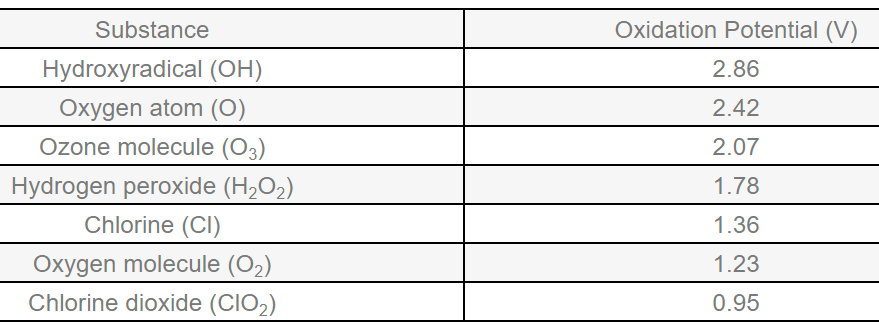
Oxidation potential, measured in volts (V), quantifies how strongly a chemical species attracts electrons, the higher the voltage, the more powerful the oxidant. As shown below, ozone is significantly more powerful than other disinfectants like hydrogen peroxide, chlorine, or chlorine dioxide, which is why ozone achieves disinfection at much lower doses and in far less contact time.


Substance

Oxidation Potential (V)

Hydroxyradical (OH)

2.86

Oxygen atom (O)

2.42

Ozone molecule (O3)

2.07

Hydrogen peroxide (H2O2)

1.78

Chlorine (Cl)

1.36

Oxygen molecule (O2)

1.23

Chlorine dioxide (ClO2)

0.95

someone teaching the formation of oxygen and ozone

How is ozone generated for water treatment?

Ozone is generated by splitting atmospheric oxygen molecules (O₂) into singlet oxygen atoms (O), which then react with remaining O₂ to form ozone (O₃). This process requires a high-energy source, either ultraviolet (UV) light or corona discharge. Corona discharge generators use high voltage to split oxygen and are the industry standard for water treatment applications, producing higher ozone purity and output than UV generators while being more cost-effective and durable over time. UV ozone generators are suitable for light-duty residential or small-scale uses, while corona discharge systems are preferred for moderate-to-heavy-duty commercial and industrial applications. Purifico ozone water treatment systems for agriculture and industry use corona discharge generators fed with concentrated dry oxygen for maximum ozone output and efficiency.

What reactions occur when ozone is added to water?

When ozone is added to water, the overall decomposition reaction is O₃ ↔ O + O₂, but many intermediate reactions occur along the way. As ozone breaks down, it naturally forms short-lived oxygen species like hydroxyl radicals (OH⁻), which are themselves powerful oxidants with an oxidation potential of 2.86 V, even higher than ozone itself. These intermediates contribute significantly to water purification beyond disinfection, beyond the direct action of ozone.

Ozone and hydroxyls play complementary roles:

  • Ozone oxidizes organic contaminants selectively, targeting molecules with double bonds, activated aromatic systems, and non-protonated amines. This selectivity makes ozone highly efficient at waterborne pathogen control and disinfection.
  • Hydroxyl radicals are unselective and react in a nearly diffusion-controlled manner, attacking virtually any organic contaminant they encounter. This makes them especially useful for breaking down persistent pollutants like pharmaceuticals and pesticides.

Together, these two oxidants form what is known as an Advanced Oxidation Process (AOP), with ozone handling disinfection and hydroxyls handling purification.

A visual representation of an ozone chemical reaction, illustrating its transformative process in breaking down pollutants and pathogens, contributing to cleaner and safer environments.